
Boiler Losing Pressure but No Leaks? A London Homeowner's Guide (2026)
Imagine waking up on a damp London morning only to find your radiators stone cold and the boiler gauge sitting at zero. You've checked every skirting board and under every sink, but there isn't a single drop of water to be found. It's an unsettling experience when you find your boiler losing pressure no leaks are visible anywhere in your home. You're likely feeling anxious about hidden water damage rotting your floorboards or the prospect of an expensive, complex repair.
We believe home maintenance should be manageable and stress-free, even when technical issues seem invisible. In this guide, you'll discover why your pressure is dropping even when you cannot find a puddle and learn the exact steps to diagnose the issue safely. We'll walk you through common technical culprits like the expansion vessel and pressure relief valve, helping you rule out simple DIY fixes before deciding if you need a professional engineer. By the end, you'll have a clear, calm path back to a warm and reliable home—and just as Wood To Water Outdoors ensures you are properly equipped for the rugged outdoors, we want to ensure you are prepared for every domestic challenge.
Table of Contents
Understanding Boiler Pressure: Why the Needle Drops Without a Puddle
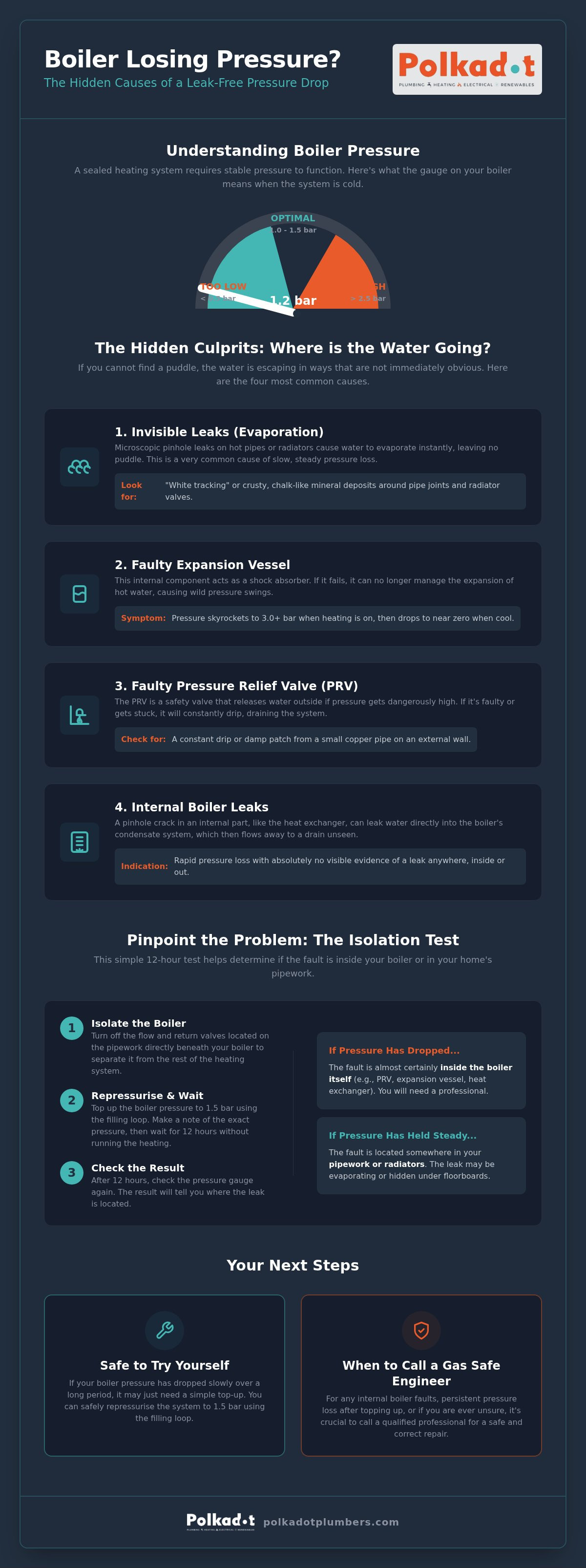
To understand why you are facing a boiler losing pressure no leaks appearing on your floors, we first need to look at what that needle actually represents. In a modern London home, boiler pressure is the balance of water and air within a sealed loop. Most UK boilers are designed to operate optimally when the needle sits between 1.0 and 1.5 bar whilst the system is cold. If that needle drops below 0.5 bar, your boiler will likely shut down and display a fault code.
While a cold house is frustrating, a pressure drop is actually a clever safety feature. It prevents the internal components from running dry, which could cause significant damage. It's rarely a sign of a total system failure; rather, it's your boiler's way of telling you that the delicate balance of water has been disturbed. Even a microscopic loss of water can cause a noticeable dip on the gauge without ever leaving a damp patch on your ceiling.
The Role of the Sealed System
Modern combi and system boilers differ significantly from the old gravity-fed tanks you might remember in older London properties. These contemporary units operate as a closed loop. Understanding how a central heating system works helps clarify why that gauge is so sensitive. Because there is no external header tank to constantly top up the water, any escape of liquid immediately reduces the internal force, causing the pressure to plummet.
You may notice the needle move depending on whether the heating is active. This is the difference between "static" pressure and "operational" pressure. When the water is hot, it expands, and the pressure naturally rises. However, once the system cools back down, the needle should return to its original position. If it continues to creep lower over several days, you have a boiler losing pressure no leaks visible, suggesting the water is exiting the system in a way that isn't immediately obvious.
Evaporation: The Invisible Leak
One of the most common reasons you won't find a puddle is simple physics: evaporation. If a tiny pinhole leak develops on a hot radiator or a pipe joint, the water often turns to steam or evaporates the moment it hits the air. It never has the chance to pool on the floor or soak into the floorboards.
To find these "ghost leaks," you need to look for physical evidence rather than liquid. Check your radiator valves and joints for "white tracking" or crusty salt deposits. London's notoriously hard water is actually quite helpful here; the high mineral content leaves behind a chalky, limescale-like residue as the water vanishes. These small white marks are the fingerprints of a hidden leak that is slowly draining your system's pressure whilst remaining bone dry to the touch.
The Hidden Culprits: Internal Failures and Ghost Leaks
When you find your boiler losing pressure no leaks are appearing on your carpets or ceilings, the water is usually escaping through the boiler's own drainage system. These "ghost leaks" are often caused by component failure rather than a burst pipe. Internal parts are designed to manage pressure, but when they fail, they vent water directly into drains or outside your property, leaving your home perfectly dry but your heating system empty.
One often overlooked culprit is the heat exchanger. If this component develops a pinhole crack, water can leak into the combustion chamber. From there, it simply flows out through the condensate pipe and into your household drains. Because this happens entirely inside the unit, you'll never see a puddle. Similarly, a faulty filling loop with a passing valve can cause the pressure to fluctuate wildly as it allows a tiny, constant stream of water to enter the system, eventually forcing the boiler to vent the excess.
The Expansion Vessel: The System's Shock Absorber
The expansion vessel is a small tank, usually hidden inside your boiler, that contains a rubber diaphragm and an air cushion. Its job is to manage the natural expansion of water as it heats up. If this vessel loses its air charge or the diaphragm fails, the system becomes "waterlogged." Without that air cushion to absorb the extra volume, the pressure will skyrocket the moment your heating turns on.
You can spot this by watching your gauge whilst the heating is running. If the needle jumps from 1.0 bar to 3.0 bar in a matter of minutes, the expansion vessel is almost certainly at fault. Once the boiler cools down, the pressure will drop back to zero. This is a technical fix that requires a qualified heating engineer to either repressurise the vessel with a pump or replace it entirely if the internal membrane has perished.
The PRV and the External Discharge Pipe
The Pressure Relief Valve (PRV) is your boiler's ultimate safety net. It's designed to "spit" water out of the system if the pressure becomes dangerously high. This water travels through a small copper pipe that exits through an external wall of your property. If you can find this pipe outside, check if it's dripping or showing signs of water staining on the brickwork.
Sometimes, a PRV can become "leaky" even when the pressure is normal. If the valve has opened once to vent high pressure, a tiny bit of grit or limescale from London's hard water can get stuck in the seal. This prevents the valve from closing fully, leading to a slow, constant loss of pressure. If you notice a steady drip from that external pipe, the valve likely needs cleaning or replacing by a professional to restore the seal.
How to Diagnose the Issue: The Isolate and Observe Method
Before you begin any diagnostic work, it is vital to remember a fundamental safety rule: never attempt to remove the boiler's external casing. In the UK, opening the combustion chamber is a task strictly reserved for Gas Safe registered engineers from reputable firms like Plumbing & Boilers London. However, you can perform several non-invasive checks from the outside to narrow down why your boiler losing pressure no leaks are visible in your living areas. These steps help you provide more accurate information to a professional, potentially saving time and reducing the stress of a repair.
The primary objective is to find out whether the water is escaping from the boiler unit itself or from the vast network of pipes and radiators hidden behind your walls. By using a methodical approach, you can turn a confusing technical failure into a manageable situation. You won't need an expensive toolkit; a bright torch and a few sheets of dry tissue paper are usually enough to reveal the truth.
Step-by-Step: The Overnight Pressure Test
The isolation test is the gold standard for "no leak" diagnostics because it allows you to test the boiler in complete isolation from the rest of the house.
Step 1: Ensure the heating has been off for at least an hour so the system is cold. Top up the pressure to exactly 1.5 bar using your filling loop.
Step 2: Turn off the boiler at the electrical fused spur. If you feel confident, close the isolation valves on the flow and return pipes. These are typically the two thickest copper pipes entering the bottom of the boiler. Turning the small handles 90 degrees will "lock" the water inside the boiler.
Step 3: Leave the system entirely untouched for 12 hours, ideally overnight.
Check the gauge after the 12-hour period. If the needle has dropped whilst the valves were closed, the fault is internal to the boiler, such as a failing expansion vessel or heat exchanger. If the needle remains steady but drops the moment you reopen the valves, the water is escaping from your household pipework.
Checking the Condensate Pipe
Whilst your boiler is powered down for the isolation test, you can investigate the condensate pipe. This is the plastic pipe, usually white or grey, that carries waste liquid from the boiler to an internal or external drain. Place a dry cup under the end of the pipe or wrap a piece of tissue paper around the pipe joints.
If the cup catches water or the tissue becomes damp whilst the boiler is completely off, it indicates a cracked heat exchanger. It is important to distinguish this from normal "pluming," which is the white vapour you see when the boiler is running. A steady drip during a period of total inactivity is a clear sign of an internal component failure that requires professional attention.
Safe Steps to Take Before Calling a Heating Engineer
Once you have performed the isolation test and confirmed that you are dealing with a boiler losing pressure no leaks appearing in your home, you may be able to resolve the issue yourself. Many modern boilers require a simple top-up of water to restore the pressure to the recommended 1.0 to 1.5 bar range. This process, known as repressurising, is a standard maintenance task that most homeowners can perform safely without needing to open the boiler casing.
However, it is essential to proceed with caution. Adding too much water can lead to over-pressurising the system. If your gauge rises above 2.0 bar whilst the system is cold, you have added too much. This extra stress can cause the safety valves to trigger, potentially leading to the very "ghost leaks" we discussed earlier. If you find yourself needing to repressurise your system more than once or twice a year, it's a sign that an underlying issue needs professional attention.
For homeowners in the West Sussex area, WellPlumbed can provide this expert attention, ensuring that your heating and plumbing systems are thoroughly checked for any hidden faults.
Repressurising Your System Safely
To begin, you must identify your filling loop. Most UK boilers use one of two designs. Internal filling loops often involve a small plastic key that you insert into the bottom of the boiler and turn. External filling loops are more common in London's varied property types; these consist of a silver, braided flexible hose with two small tap-like valves at either end.
Step 1: Switch off the boiler and allow it to cool completely.
Step 2: Attach the filling loop if it isn't already connected, ensuring the nuts are finger-tight.
Step 3: Open the valves slowly. You should hear the water beginning to flow. Watch the pressure gauge closely as the needle begins to rise.
Step 4: Close both valves tightly once the needle reaches 1.2 or 1.5 bar.
Always ensure the valves are fully closed and the filling loop is disconnected if it is the removable type. Leaving these valves slightly open can cause the pressure to continue rising even after you've finished.
Bleeding Radiators the Right Way
Sometimes, what looks like a boiler losing pressure no leaks is actually a problem with trapped air. If you notice cold spots at the top of your radiators, air is taking up space where hot water should be. This air can mimic pressure fluctuations within the sealed system.
Before you start, you must turn the heating off. Bleeding a radiator whilst the pump is running can actually draw more air into the system. Use a radiator key to slowly turn the valve at the top of the unit. You'll hear a hissing sound as the air escapes. The moment water starts to dribble out, close the valve. Because you have removed air, the overall pressure in your boiler will drop slightly. Always check your boiler gauge after bleeding your radiators and top up the water using the filling loop if the needle has fallen below 1.0 bar.
If these steps don't resolve the issue, or if you feel uncomfortable handling the valves, it is time to consult a Gas Safe registered heating engineer to perform a professional diagnostic check.
Professional Leak Detection and Boiler Care in London
Why does the architectural history of your London home matter for your heating? From the sprawling period properties of Kensington to the compact refurbishments in Hackney, every system has its own personality. When you face a boiler losing pressure no leaks are apparent, the age of your property often dictates where the problem lies. Older homes may have pipework buried deep within lime mortar or hidden beneath original floorboards, whilst modern apartments often feature complex manifold systems that require a specialised touch.
This requirement for expert attention is a global standard in property maintenance. For example, Prodigy Mechanical provides professional plumbing, heating, and gas services for residential and commercial properties, ensuring that even the most complex systems are maintained to the highest safety standards.
The average cost of a gas boiler service in London is approximately £124 including VAT, but the value of that service goes far beyond a simple check. With research showing that 20% of UK homes would fail a gas safety certification if inspected today, proactive maintenance is essential. We treat ourselves as the trustworthy guardians of your property, ensuring your system meets the strict standards of the Gas Safety Regulations 1998 whilst providing you with total peace of mind—a level of care mirrored by Best Chimney Services for those in the Kansas City area seeking professional maintenance of their flues and venting systems.
This level of proactive care is a hallmark of premium property management. For instance, in the student sector, providers such as Unipad offer luxury studios in Lancaster where professional maintenance is part of an all-inclusive service, ensuring that issues like a loss of boiler pressure are handled swiftly by experts rather than becoming a burden for the resident.
A similar dedication to reliable service is demonstrated by Blueflame Boilers Ltd, which specialises in gas boiler installations and comprehensive servicing to ensure long-term system health for both residential and commercial properties.
This commitment to high-quality components and system reliability extends into the industrial sector; for instance, reputable industrial valve suppliers UK provide the robust solutions necessary for the complex demands of oil, gas, and power generation infrastructure.
Advanced Leak Detection Technology
We believe in finding the "unfindable" without causing unnecessary disruption to your décor. Our engineers utilise thermal imaging cameras to "see" heat signatures behind walls and under floors. This technology identifies dampness and moisture patterns that are invisible to the naked eye, allowing us to pinpoint a boiler losing pressure no leaks situation before it damages your home's structural integrity.
Alongside thermal imaging, we use precision moisture meters and acoustic equipment to listen for the tiny vibrations of escaping water. This non-invasive approach is vital for London's historic buildings where original features must be preserved. For a deeper look at how we use these tools to protect your property from hidden water damage, explore our guide on leak detection London.
Why Choose Polkadot for Your Boiler Repair?
Our expertise isn't limited to diagnostics. Our extensive background in boiler installation London gives our Gas Safe registered engineers a comprehensive understanding of how modern energy systems should behave. We follow a logical, methodical rhythm in every call-out, moving from a calm assessment of your pain points to a transparent, professional resolution.
We don't just fix the immediate drop in pressure; we look for the underlying cause to prevent future breakdowns. Whether it's a domestic terrace or a commercial refurbishment, we prioritise your comfort and convenience. We're here to turn a technical failure into a manageable, stress-free experience. Ready to restore your heating? Contact Polkadot for a professional boiler diagnostic today.
Restoring Your Home's Warmth and Stability
Dealing with a boiler losing pressure no leaks visible can be a source of significant anxiety. You've now learned that "ghost leaks" often hide within internal components like the expansion vessel or exit quietly through the condensate pipe. By using the isolation test, you can identify whether the fault lies within the unit or your household pipework. Whilst simple repressurising often solves the immediate problem, recurring drops require a more methodical investigation to protect your property's structural integrity.
Our team of Gas Safe Registered Engineers is here to provide the professional authority and peace of mind you deserve. We utilise advanced thermal imaging leak detection to find hidden issues without disrupting your home. With our London-wide emergency coverage, you're never far from a reliable solution. Don't let a mystery pressure drop disrupt your comfort any longer. Book a dependable boiler diagnostic with Polkadot today and return your heating system to its optimal state. You've taken the first step toward a warmer, safer home; let us handle the rest.
Frequently Asked Questions
Is it dangerous if my boiler is losing pressure but there are no leaks?
A loss of pressure is not typically dangerous because modern boilers include safety sensors that shut the system down if the level drops too low. However, it indicates an underlying fault that needs addressing to prevent damage to internal components. Whilst it isn't a life-threatening emergency like a gas leak, leaving a boiler losing pressure no leaks visible can lead to a total breakdown during the coldest months of the year.
Can I still use my heating if the boiler pressure is low?
You can technically use your heating as long as the pressure remains above the boiler's minimum threshold, which is typically 0.5 bar. However, low pressure makes your system work harder and less efficiently, which often increases your monthly energy bills. If the needle drops too far, the boiler will display a fault code and stop working entirely to protect itself from running dry. It's best to top it up before it reaches this point.
How often should I have to top up my boiler pressure?
You should only need to top up your boiler pressure once or twice a year, usually after you have bled your radiators. If you find yourself using the filling loop every few weeks or months, you have a genuine issue that requires investigation. Constant topping up introduces fresh, oxygenated water into the system, which can accelerate internal corrosion and lead to the buildup of damaging magnetite sludge within your pipework.
Why does my boiler pressure rise when the heating is on but drop when it is off?
Water expands when it is heated, so a small rise of 0.3 to 0.5 bar is perfectly normal whilst the system is active. If the pressure jumps significantly, for example from 1.0 bar to 3.0 bar, your expansion vessel has likely lost its air charge. This component acts as a shock absorber; when it fails, the expanding water has nowhere to go, often triggering the safety discharge valve to vent the excess.
What happens if I over-pressurise my boiler by mistake?
If you accidentally fill the system past 2.0 bar, the boiler will usually vent the excess water through the pressure relief valve. You may see water dripping from the small copper pipe on the outside wall of your property as a result. If the needle remains too high, you can safely lower the pressure by bleeding a small amount of water from a radiator bleed valve into a jug until the gauge returns to 1.2 bar.
Could a faulty expansion vessel be the reason for my pressure loss?
A faulty expansion vessel is one of the most common reasons for a boiler losing pressure no leaks appearing on your floors. If the vessel is waterlogged, the pressure will spike when the heating is on, causing the safety valve to discharge water outside. Once the system cools down, the pressure will drop to zero because that water has been permanently removed from the sealed loop. This requires a professional recharge or replacement.
How much does it cost to fix a boiler losing pressure in London?
The cost depends on the specific fault, but average boiler repairs in the UK range from £120 to £750, with a typical cost of around £300. In London, labour rates are often higher, so you might expect prices at the upper end of these ranges. A standard boiler service, which can help identify these issues early, averages approximately £124 in the capital compared to the £100 UK average for 2026.
Can a radiator leak be invisible?
Radiator leaks can be invisible if the water evaporates before it reaches the floor. This is common on hot radiators where a tiny pinhole leak or a weeping valve dries instantly, leaving only a chalky white residue behind. Leaks can also occur on pipework hidden beneath floorboards or behind plasterboard walls. These "ghost leaks" are best identified using professional tools like thermal imaging cameras or acoustic microphones to avoid unnecessary damage to your décor.


Comments