
Boiler Installation London: A Comprehensive Guide to Reliable Heating (2026)
Why wait for the first frost of 2026 to discover your old G-rated boiler has finally given up? It's a common anxiety for many residents who face rising energy bills and the constant threat of a mid-winter breakdown. Arranging a professional boiler installation London homeowners can rely on is about more than just swapping a unit; it's a strategic investment in your property's long-term comfort and efficiency. We understand that the process often feels overwhelming, especially when you're caught between confusing technical jargon and the fear of hiring an unreliable installer.
You deserve a heating system that works silently and effectively in the background. This guide simplifies the transition by providing expert advice on the latest efficiency standards, current government grants like the Boiler Upgrade Scheme, and the practical differences between Combi and System setups. We'll explore how to identify professional Gas Safe standards and what you need to know about the 2026 regulations for existing homes. This roadmap moves you from technical uncertainty to a clear understanding of your next steps for a warmer, more dependable home.
Table of Contents
Recognising When Your London Home Needs a New Boiler Installation
Deciding between a quick fix and a full boiler installation London project requires a diagnostic mindset. Many London properties rely on ageing systems that are no longer fit for purpose. When a heat exchanger begins to fail or a pump struggles to circulate water, the symptoms are often subtle before becoming catastrophic. Identifying these warning signs early helps you avoid the stress of a total system failure during the coldest months of the year.
Common Symptoms of Boiler Fatigue
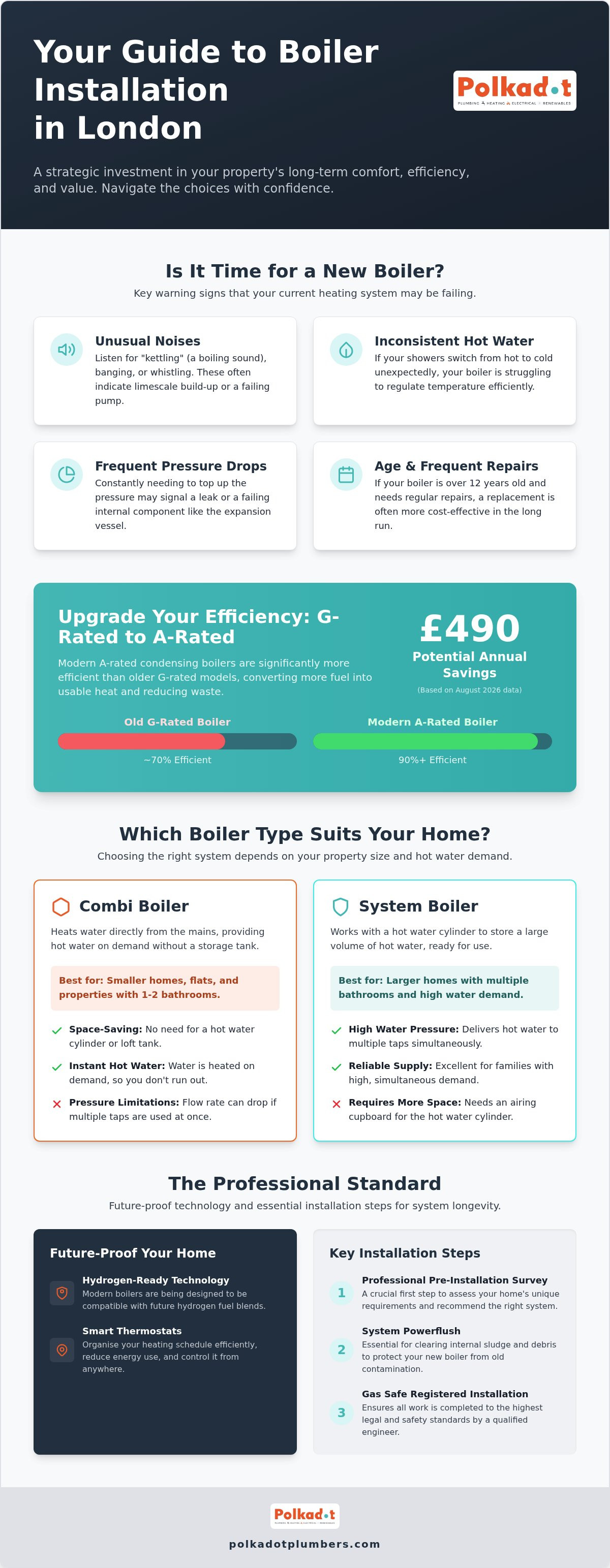
Listen to your system for unusual sounds. Strange noises like "kettling", which sounds like a boiling kettle, often indicate a buildup of limescale or sludge within the heat exchanger. Banging or whistling sounds suggest air trapped in the system or a failing pump. Beyond the noise, inconsistent hot water is a major red flag. If your morning routine is regularly interrupted by cold showers, your boiler is likely struggling to regulate temperature efficiently. Frequent pressure drops are equally concerning. If you find your boiler losing pressure frequently, it might signal a leak or a terminal expansion vessel failure that requires professional intervention.
Every boiler eventually becomes a "money pit". If your unit is over 12 years old and requires frequent call-outs, the cumulative cost of parts and labour often exceeds the value of the machine itself. Modern boiler technology has advanced significantly, making older G-rated models obsolete in terms of both performance and safety. Replacing a failing unit isn't just a repair; it's an upgrade to your home's infrastructure that supports modern lifestyle requirements like high-pressure showers and reliable heating.
Efficiency Gains: From G-Rated to A-Rated
The ErP (Energy-related Products) rating system provides a clear efficiency benchmark for homeowners. Upgrading from an old G-rated model to a modern A-rated condensing unit is a transformative step for your household finances. Data from August 2026 shows that this upgrade can save homeowners up to £490 per year on energy bills. These savings are particularly impactful in London, where energy costs remain a primary concern for many households. Whilst the boiler does the heavy lifting, combining it with modern insulation and smart controls helps maintain these efficiency gains by significantly reducing heat loss. A new boiler installation London ensures your property is prepared for the future, reducing your carbon footprint whilst providing the peace of mind that comes with a dependable heating system.
Deciphering Boiler Types: Which System Best Suits Your Property?
Choosing the right hardware for a boiler installation london project depends heavily on your property's architecture and your household's daily water usage. London's diverse housing stock, ranging from compact studio flats in Southwark to sprawling Victorian terraces in Hampstead, requires a tailored approach to heating. You must consider whether your priority is saving cupboard space or ensuring three showers can run simultaneously without a drop in temperature.
The Pros and Cons of Combi Systems
Combination boilers, or "combis", are the most frequent choice for London apartments and smaller houses. These units act as both a high-efficiency water heater and a central heating boiler in one compact box. Because they heat water directly from the mains, you don't need a bulky cold water tank in the loft or a hot water cylinder in an airing cupboard. This makes them perfect for kitchen-integrated installations where every square inch of storage matters.
Instant Hot Water: There is no waiting for a tank to refill; the water is heated on demand.
Space Efficiency: The lack of external tanks frees up valuable loft or cupboard space for storage or room conversions.
Pressure Limitations: Whilst efficient, combis can struggle if multiple taps are used at once. If your household has more than two bathrooms, the flow rate might prove frustrating during the morning rush.
System and Regular Boilers for High Demand
For larger family residences, a system or regular boiler is often more appropriate. A system boiler works with a separate unvented hot water cylinder, allowing it to deliver high-pressure water to multiple outlets at the same time. The professional body for the UK plumbing and heating industry notes that these setups are particularly effective in homes with modern, high-flow showerheads that require significant volume.
Regular (conventional) boilers are still common in older London properties that have traditional radiator networks. These systems utilise both a cylinder and a cold water storage tank in the loft. If you are planning to eventually transition to renewable energy, such as solar thermal or air source heat pumps, these cylinder-based systems are often easier to adapt. This future-proofing ensures your investment remains relevant as London moves toward lower-carbon heating solutions. If you are navigating these technical choices for the first time, a professional heating assessment can help determine which configuration matches your property's pipework and your family's needs.
Evaluating Modern Heating Technology and Future-Proofing
How do you ensure your new heating system remains efficient for the next decade? Modern technology has moved beyond simple on/off switches. When planning a boiler installation london residents should look for "Load Compensation" features as a standard requirement. This technology allows the boiler to adjust its heat output based on the actual temperature inside your home. Instead of firing at full capacity and then shutting off abruptly, the system modulates its flame. This reduces unnecessary wear on internal components and prevents the energy spikes that often drive up monthly utility bills.
While reliable heating is the priority during the winter months, many homeowners now seek year-round climate control. Integrating a new boiler with a professional air conditioning installation provides a comprehensive solution for your property. This dual approach ensures your home remains a comfortable sanctuary regardless of external temperature fluctuations, moving away from the "one-size-fits-all" heating methods of the past.
Smart Controls and Thermostats
Are you still heating an empty house whilst you're at work? Smart thermostats allow you to organise your home heating with surgical precision. Zonal heating technology enables you to warm only the rooms you are actually using, such as the kitchen in the morning or the bedrooms at night. Remote access via smartphone apps means you can adjust your settings whilst on the commute home, ensuring a warm welcome without wasting gas during the day. Over time, these sophisticated systems learn your behaviour and automatically optimise your usage patterns. This creates a more efficient household without requiring constant manual adjustments.
Hydrogen-Ready and Hybrid Readiness
What does the UK government's roadmap mean for your domestic gas heating? Most modern boilers are now manufactured as "hydrogen-ready", meaning they can operate on a 20% hydrogen blend without any modifications to your existing setup. This is a vital consideration for your investment; it ensures your system won't become obsolete if the national gas fuel supply changes in the coming years. Additionally, we often design new installations to be "hybrid-ready". This involves preparing your pipework so that an air source heat pump can be integrated at a later date. This flexible path allows you to adopt greener energy solutions as technology and infrastructure continue to evolve across London.
The Step-by-Step Professional Installation Process
A professional boiler installation london project begins long before the first pipe is cut. Why is a pre-installation survey essential for your home? It allows a qualified engineer to assess your existing pipework, current water pressure, and the specific flue position required for safety. Remote quotes often miss these critical site-specific details, which can lead to unexpected technical hurdles or price increases on the day of work. A physical visit ensures the quote you receive is accurate and comprehensive, giving you a clear path forward without hidden surprises.
The Importance of a Powerflush
A Powerflush is a chemical deep-clean for your central heating. Debris and magnetite sludge in old radiators can quickly damage the delicate internal components of a brand-new boiler. By removing these contaminants, you improve heat distribution and reduce system noise amongst older pipes. This protective measure ensures your new investment operates at peak efficiency from day one, preventing premature wear on the heat exchanger and maintaining your manufacturer warranty.
London Logistical Considerations
Installing a boiler in the capital presents unique challenges that out-of-town providers often overlook. We handle the coordination of parking permits and Congestion Charge zones to ensure our engineers arrive on schedule and focus entirely on the technical task. In many London flats, specific flue regulations must be strictly followed to ensure safety and compliance with Building Regulations. We also organise the safe disposal of your old boiler and any redundant components, leaving your home clean and functional after the work is complete.
The commissioning and handover process is the final step in securing your home's comfort. This isn't just about turning the unit on; it involves a methodical series of safety checks to verify gas flow, flue integrity, and water tightness. Every installation must be registered with Gas Safe, the non-negotiable standard for British heating services. Once the system is certified, we take the time to walk you through the new interface. We'll ensure you know how to adjust settings and understand the maintenance schedule required to keep your home warm and efficient. If you're ready to begin, you can book your professional heating survey with our London experts today.
Choosing a Dependable London Installer for Peace of Mind
Selecting the right team for your boiler installation london project involves more than comparing bottom-line figures. Whilst some providers compete solely on price, this approach often leads to cut corners in complex urban environments. London's unique property landscape, from high-rise apartments to heritage terraces, requires an installer who understands specific flue regulations and the intricacies of Victorian pipework. You need a partner who views your heating system as a vital part of your home's infrastructure, not just a hardware swap.
There is significant value in choosing a multi-trade company that can handle more than just the gas connection. If your new boiler is part of a larger kitchen or bathroom refurbishment, having a single point of contact ensures that electrical work, plumbing, and structural changes are perfectly coordinated. This integrated approach reduces the stress of managing multiple contractors and ensures that your heating system is designed to complement your home's new layout and demand requirements.
Verifying Credentials and Reviews
How do you distinguish a professional from a "cowboy" installer? Your first step should always be to verify their Gas Safe Register status. Don't simply take a logo at face value; ask to see the engineer’s ID card and check that they are qualified for the specific type of work you require. Beyond legal compliance, look for companies that offer comprehensive workmanship guarantees. These provide an essential safety net, ensuring that the quality of the installation is protected long after the engineer leaves your property. When reading testimonials, focus on how the company handles challenges. A dependable provider is transparent about their process and maintains clear communication even when technical hurdles arise.
The Polkadot Approach to Heating
We position ourselves as the trustworthy guardian of your property. Our approach is built on diagnostic expertise; we don't just fix symptoms, we identify the root cause of system fatigue to prevent future breakdowns. This methodical rhythm creates a sense of efficiency and transparency for every client. We understand that a boiler failure is a high-stress event, and our goal is to act as a stabilising force in your home. By providing professional authority alongside an empathetic, customer-first service, we move you quickly from a state of uncertainty to a clear, warm, and dependable outcome. We treat every boiler installation london project as a long-term commitment to your comfort, ensuring your home remains a sanctuary regardless of the weather outside.
Securing Your Home’s Future with Reliable Heating
Transitioning from a failing, inefficient unit to a modern heating system is a significant step toward property stability and reduced energy costs. We've explored how to identify terminal symptoms like frequent pressure drops and why matching your boiler type to your specific London property is essential for daily comfort. By integrating smart controls and hydrogen-ready technology, you ensure your investment remains efficient and compliant as national standards evolve.
A successful boiler installation london project relies on professional integrity and technical precision. At Polkadot, our Gas Safe Registered Engineers provide expert coverage for both domestic and commercial properties across the city. We stand behind our quality of service with a comprehensive 12-month workmanship guarantee; this gives you the peace of mind you deserve. Don't leave your winter comfort to chance. Book your dependable boiler installation survey with Polkadot today and take the first step toward a warmer, more efficient home. We're ready to help you navigate this transition with ease.
Frequently Asked Questions
How much does a new boiler installation cost in London?
Factors such as the boiler type, property size, and complexity of pipework determine the final investment. London installations often carry a premium due to higher operational costs and logistical challenges like parking and congestion charges. A straightforward like-for-like swap is generally more affordable than a full system conversion. We recommend a professional site survey to receive a precise, transparent quote tailored to your home's unique requirements.
How long does it take to install a new boiler?
A standard like-for-like boiler swap typically takes between one and two days. If you are converting from a traditional system to a combi boiler, the process usually extends to three or four days because of the additional pipework and tank removal required. Complex projects involving relocation or multiple zones may take longer. We prioritise a methodical approach to ensure every safety check is completed without rushing the commissioning process.
Do I need a Combi, System, or Regular boiler for my flat?
Most London flats benefit from a compact combi boiler because it eliminates the need for external water tanks and cylinders. However, if your flat has multiple bathrooms or very high hot water demand, a system boiler with an unvented cylinder might be more appropriate. Your choice depends on available cupboard space and your existing plumbing infrastructure. A diagnostic assessment helps determine which unit provides the best balance of efficiency and performance.
Is it mandatory to use a Gas Safe registered engineer for boiler installation?
Yes, it is a legal requirement in the UK for anyone performing gas work to be on the Gas Safe Register. This ensures that your boiler installation london project meets strict safety standards and complies with building regulations. Using an unregistered installer is dangerous and will invalidate your manufacturer's warranty and home insurance. Always ask to see an engineer's ID card to verify their current qualifications before any work begins.
Can I move my boiler to a different room during installation?
You can relocate your boiler, although this involves additional labour and materials for extending gas pipes, water lines, and the flue system. Common relocations include moving a unit from a bedroom to a kitchen or loft space to reclaim living area. Whilst this adds complexity to the installation, it often improves the overall functionality of your home. We evaluate the feasibility of your preferred location during the initial pre-installation survey.
What is a Powerflush and do I really need one with a new boiler?
A Powerflush is a chemical deep-clean that removes sludge, rust, and debris from your central heating circuit. Most manufacturers require this process during a new boiler installation london to protect the new heat exchanger from contamination. Without it, old debris can quickly settle in your new unit, causing efficiency drops or internal damage. It is a vital maintenance step that ensures your new system operates quietly and effectively for years.
Will a new boiler installation help me pass an EPC assessment?
Upgrading to a modern A-rated condensing boiler significantly improves your property's Energy Performance Certificate (EPC) rating. Because new units are over 90% efficient, they reduce carbon emissions and estimated fuel costs, which are key metrics in the assessment. Combining the new boiler with smart thermostats and thermostatic radiator valves provides even greater gains. This makes your property more attractive to future buyers or tenants whilst lowering your utility bills.
What happens if my new boiler loses pressure shortly after installation?
It is common for pressure to fluctuate slightly as air settles out of a newly filled system. However, if the pressure drops significantly, it may indicate a small leak or air trapped in a radiator. You should contact your installer immediately to perform a diagnostic check. We provide a 12-month workmanship guarantee to address these minor adjustments, ensuring your system remains stabilised and dependable during its first year of operation.


Comments